

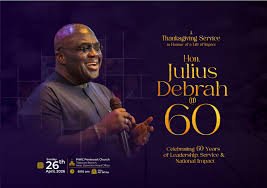
Today, we celebrate the life and service of Hon. Dr Samuel Julius Debrah—a man who turns 60 with a legacy that speaks louder than titles.
This is not merely a birthday salute; it is a tribute to a journey. A journey that began in a quiet village setting rose through discipline and learning and eventually climbed—step by step—into the nation’s highest places of responsibility.
Some people are born into influence. And then some people build influence—through character, work, and unwavering commitment. Dr Debrah belongs to the second category. His story is the kind that makes Ghanaians proud, because it reminds us that humility can lead to greatness, and consistency can lead to impact. Born April 24, 1966, in Akorabo near Suhum in the Eastern Region of Ghana, Dr Debrah’s early life carried the marks of deep family grounding and honest labour.
His father, James Debrah, worked in Cocoa services—first as a cocoa services officer and later retiring as the Regional Cocoa Officer for the Eastern Region.
His mother, Kate Opoku, was a trader who later ended up a transporter.
In that household, discipline was not theory—it was daily practice. Leadership was not something you claimed; it was something you demonstrated through responsibility. From childhood, Dr Debrah moved through schools that reflected structure and purpose—CRIG Primary A at Tafo, Wisdom Preparatory School at Koforidua, and later a return to Akorabo when his father retired in 1974.
He continued his education at Akorabo LA Primary A, then Amede Presby Middles School, proceeded to Mpraeso Secondary School for his O’ Level, and later to the illustrious Achimota School for his A’ Levels. Even at this stage, you could sense the hallmark of his life: he did not run away from effort.
He walked toward progress. But what truly makes Dr Debrah’s life inspiring is not only the path he followed; it is the depth of the path. He eventually progressed to the University of Ghana, where he earned his BA, MA, and PhD.
His academic journey—Archaeology and Sociology for his first degree; Archaeology and Heritage Studies with specialisation in Museums and Heritage for his Master’s; and Heritage & Tourism Development in Kwahu for his Doctorate—shows a mind that does not only chase power, but pursues meaning.
He did not just learn to talk. He learned to understand systems, communities, history, culture, and the ways people build identity. And after so much education, he still returned to life’s practical disciplines. From Achimota, he went straight to Okaishie market to do business. That detail matters. It tells you that he did not remain an academic in theory—he embraced the real world.
He built a foundation through enterprise. He learned what it means to walk with the people, serve the people, and understand the everyday struggle that shapes the nation’s heart. By the time the year 2005 arrived, Dr Debrah had already lived multiple chapters—family responsibility, education, business, and the beginnings of political engagement. Yet, he still chose to advance. He went back to the UK for his undergraduate programme in 2005, a combined major in Archaeology & Sociology, further strengthening the intellectual backbone of his worldview.
Then came public service. Dr Debrah’s political journey is not the story of someone who woke up suddenly to ambition. It is a story of steadfast participation—a man who entered the political arena through party work, struggle, and dedication. He is known as a three-time parliamentary candidate for the NDC in Suhum—in 2000, 2004, and 2012. Three attempts are not a small thing. They reveal something essential: resilience. They reveal someone who remained present even when the results were not immediately theirs to celebrate.
Before his elevation, Dr Debrah served as the Eastern Regional Propaganda Secretary of the National Democratic Congress (NDC)—what we now call the Communication Officer. Those roles are not glamorous. They are demanding. They require clarity, discipline, and the ability to speak to people in a way that carries conviction. Yet, it was through that groundwork that he earned the trust that later placed him at the helm. In 2005, he became the party’s Eastern Regional Chairman, occupying that position until the NDC won the 2008 election—and after that victory, he was appointed CEO of the Ghana Tourism Board (now Ghana Tourism Authority).